What to Do After a Car Accident in Florida: A Step-by-Step Guide
The decisions you make in the first few minutes after a crash directly determine your health recovery, your insurance claim, and your legal rights. Here is exactly what to do — step by step.
6.18 million car accidents occurred in the U.S. in 2024 — resulting in an estimated 39,345 fatalities.
“I’ve been insuring Florida drivers since 2023 and I can tell you this: the clients who come out of accidents the best aren’t the ones who had the least damage — they’re the ones who knew exactly what to do. Adrenaline kicks in, your hands are shaking, and your mind goes blank. That’s why I created this guide — and why every Stay Blessed Insurance client gets our Emergency Action Card in the mail. Print this, save it, share it. Nobody should ever be left wondering what to do next.”
The 10 Steps to Take After a Car Accident
Florida Drivers: The 14-Day PIP Rule
Florida law requires you to seek medical treatment within 14 days of an accident to activate your Personal Injury Protection benefits. You then have 30 days to file the actual PIP claim with your insurer.
1
Stop the Vehicle and Ensure Everyone’s Safety
The instant a collision occurs, stop the vehicle immediately and stay at the scene. In every U.S. state, leaving the scene of an accident is a criminal offense.
If the vehicles are drivable, move them to the shoulder or a nearby parking area to prevent secondary collisions. Activate your hazard lights immediately.
2
Call 911 and Report the Accident
Call 911 immediately. If anyone is injured, this is not optional. Even with no visible injuries, police documentation is essential.
When officers arrive, give accurate, factual accounts only. Do not speculate about fault or apologize in any form.
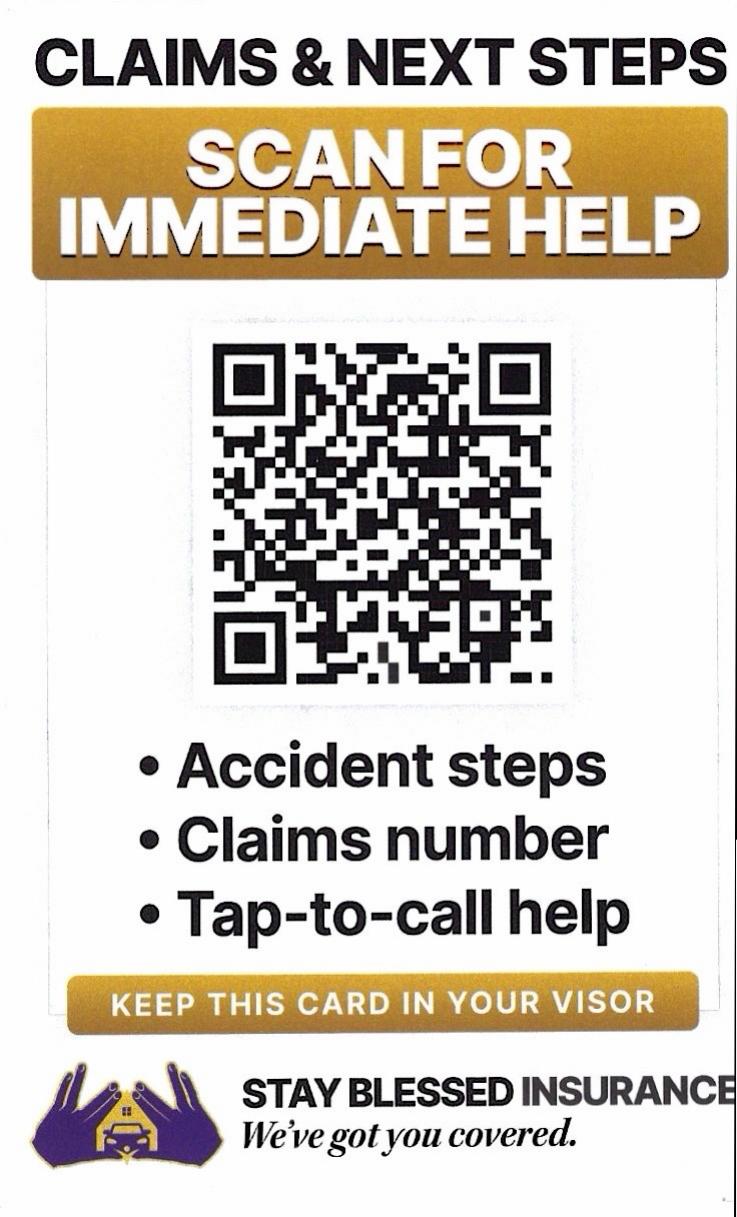
Stay Blessed Insurance client? Visit our Emergency Action Plan page for immediate step-by-step guidance, your claims number, and tap-to-call help.
Always call 911 — even in minor accidents. The police report is your most important document.
3
Seek Medical Attention Immediately
One of the most dangerous mistakes after a collision is declining medical evaluation because you feel fine. Adrenaline can suppress pain entirely.
Every driver and passenger involved in a crash should seek medical attention within 24 hours. In Florida, remember the 14-day PIP rule.
Even if you feel fine — get checked. Florida’s 14-day PIP deadline waits for no one.
4
Exchange Information at the Scene
Exchange information with every driver involved. Photograph the other driver’s insurance card and driver’s license rather than writing things down.
Category
What to Collect
Driver Info
Full legal name, address, phone number
License
Driver’s license number
Vehicle
Make, model, year, color, license plate
Insurance
Company name, policy number
Witnesses
Full name and phone number
Officer
Name, badge number, report number
5
Document the Accident Evidence
Your smartphone is your most powerful tool. Photograph every vehicle from multiple angles and capture road conditions, signals, signage, weather, and debris.
Record a narrated video covering the time, date, location, and observable conditions while they are still fresh.
6
File a Police Report
Never skip the police report, even in minor accidents. It is the official third-party record that insurance companies and courts rely on.
7
Contact Your Insurance Company
Report the accident promptly. Have your police report number, the other party’s information, and your photos ready when you call.
Do not accept any settlement offer before the full extent of your injuries and vehicle damage is known.
Your insurer’s adjuster will assess the damage — the more documentation you have, the stronger your claim.
Coverage Type
What It Covers
Collision
Damage to your vehicle, regardless of fault
Bodily Injury Liability
Another driver’s injury or death caused by you
Property Damage Liability
Damage you cause to another person’s vehicle or property
Uninsured Motorist
Damages when the at-fault driver has no insurance
PIP Florida
Medical expenses and lost wages regardless of fault
8
Consult a Car Accident Attorney When Necessary
Not every accident requires legal representation, but serious injuries, disputed liability, uninsured drivers, or multi-vehicle collisions may require legal help.
9
Avoid These Critical Post-Accident Mistakes
Understanding what not to do is just as important as the steps above.
⚠ Never Do These After an Accident
✕ Leave the scene
Before speaking with police or exchanging information.
✕ Admit fault or apologize
Even casually. “I’m sorry” can be interpreted as liability.
✕ Post online
Adjusters and attorneys may monitor social media.
✕ Delay your claim
Delays can create coverage disputes.
✕ Skip medical evaluation
Florida’s 14-day PIP deadline is strict.
Every wrong move after an accident has a cost. Know the steps before you ever need them.
10
Special Scenarios — Hit-and-Run, Rideshare & More
Hit-and-run: Stay at the scene, call 911, and note identifying details about the fleeing vehicle.Rideshare and commercial vehicles: Gather company name, vehicle markings, driver employment information, and insurance details.Minor accidents: Even when damage looks minimal, notify your insurance company and document everything.
STAY BLESSED INSURANCE — EXCLUSIVE CLIENT BENEFIT
Already a Client? You’re Already Prepared.
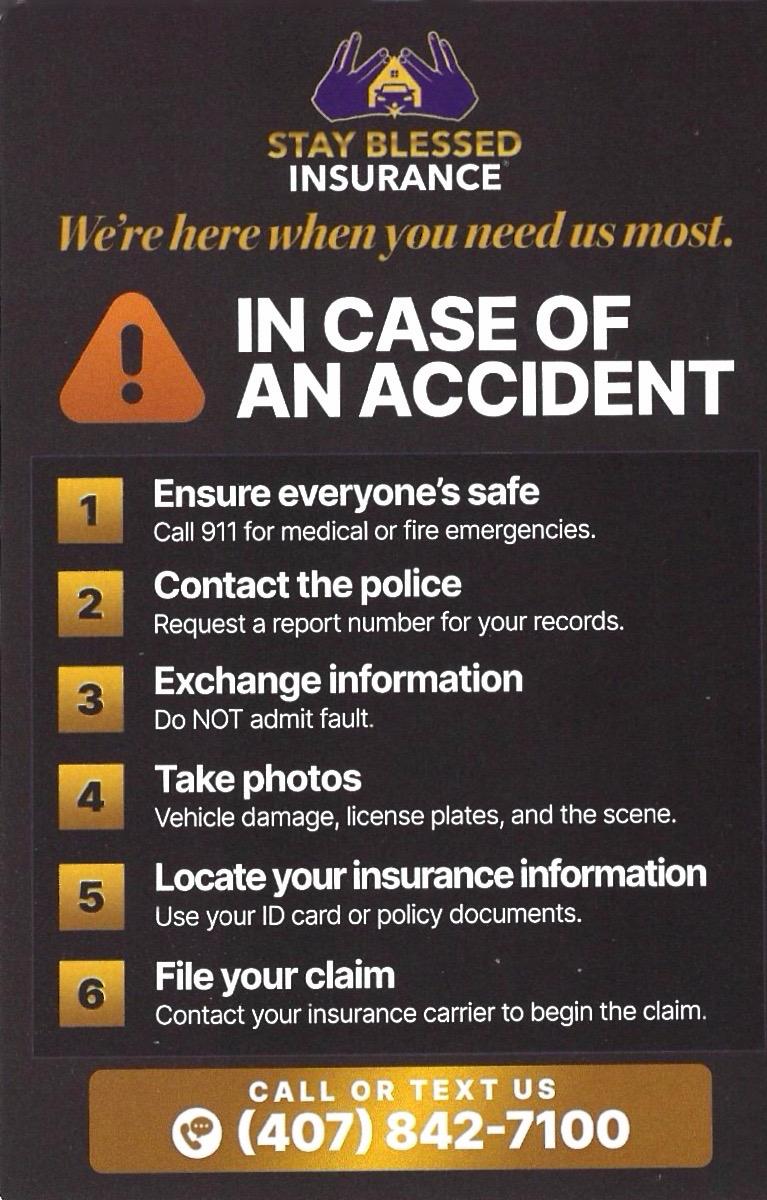
Every Stay Blessed Insurance policyholder receives our Emergency Action Plan card in the mail — a physical 4”x6” card designed to live in your glove box or visor. When an accident happens, pull it out. Everything you need is right there: a QR code for immediate step-by-step guidance, your claims number, and tap-to-call help. No confusion, no panic, no forgotten steps.
Should I call the police for a minor accident with no injuries?
Yes. A police report creates an official record that can be essential if injuries or damage appear later. Many states legally require reporting when damage exceeds a certain threshold. If officers don’t respond, file at your local station or online.
How long after an accident can I file a claim?
Most policies require notification within 24 to 72 hours. Contact your insurer as soon as possible — delays create coverage complications regardless of policy language.
What if the other driver has no insurance?
File a police report, document the scene thoroughly, and contact your own insurer to activate uninsured motorist coverage. Approximately 1 in 7 U.S. drivers is uninsured, so this is more common than most people expect.
Can I get compensation if I was partially at fault?
In Florida, yes — as long as your share of fault does not exceed 50%. If you are 50% or less at fault, you can still recover compensation, but the amount is reduced in proportion to your share of responsibility.
What if symptoms appear days after the accident?
Delayed-onset injuries are extremely common after crashes — especially whiplash, back pain, and soft tissue damage. Seek medical attention immediately, notify your insurer, and make sure your doctor documents the connection to the accident.
STAY BLESSED INSURANCE • FLORIDA AUTO QUOTES
Ready to see what 2026 rates look like for you?
We shop 50+ carriers at once, so you don't have to fill out the same form a dozen times. About two minutes. No obligation.
Disclaimer: This blog is for informational purposes only and does not constitute legal or insurance advice. Statistics are sourced from the National Highway Traffic Safety Administration (NHTSA) and other publicly available government and research databases. Readers should consult a licensed attorney or insurance professional for guidance specific to their circumstances.
Benny Aminov is the Founder and Licensed Insurance Broker at Stay Blessed Insurance. He works with Florida drivers statewide to compare coverage options, evaluate carrier offerings, and make informed insurance decisions in an evolving insurance market.
Confirmation
Watch Demo
Thank You!
Thank you so much for the info.
PIP (Personal Injury Protection): Helps cover medical expenses, lost wages, and more for you and your passengers after an accident, regardless of fault.
PD (Property Damage): Pays for damage to someone else's property caused by your vehicle during an accident.
Covers medical costs, pain and suffering, and legal fees for injuries you cause to others in an accident
Used for general personal activities, such as running errands or leisure driving.
Used mainly for recreational activities and weekend driving.
Used for business purposes, such as meeting clients or transporting goods (excluding rideshare and artisan uses)
Used for ridesharing services like Uber or Lyft.
Used by tradespeople (e.g., carpenters, plumbers, electricians) to carry tools and materials to job sites.
Think of this as "everything else" insurance. It covers damage to your car that isn't caused by a collision, such as theft, vandalism, or natural disasters. If a tree falls on your car, comprehensive coverage helps pay for repairs.
If you choose a $0 deductible, your insurance will cover the full cost of repairs for covered damages without requiring you to pay anything upfront. This option provides the highest coverage but usually comes with higher premiums.
If you choose a $250 deductible, you will pay the first $250 of the repair costs for covered damages. Your insurance will cover the rest. This option balances affordability and coverage.
If you choose a $500 deductible, you will pay the first $500 of the repair costs for covered damages. This option often comes with lower premiums compared to smaller deductibles.
If you choose a $1,000 deductible, you will pay the first $1,000 of the repair costs for covered damages. This option usually offers the lowest premiums but requires a higher out-of-pocket expense in the event of a claim.
I do not need comprehensive coverage (not recommended if you have a lienholder or want coverage for non-collision damages like theft or weather events).
Think of this as "crash damage" insurance. Collision coverage pays to repair or replace your car if it's damaged in an accident—whether you hit another vehicle, a pole, a curb, or your car rolls over. It protects your car regardless of who is at fault.
$0 Deductible: You pay $0 toward repairs. Insurance covers the full amount. Highest protection, higher premiums.
$250 Deductible: You pay the first $250 of repair costs. Insurance covers the rest. A strong balance between cost and protection.
$500 Deductible: You pay the first $500. Usually lowers the monthly premium compared to smaller deductibles.
$1,000 Deductible: You pay the first $1,000. Lowest premium option, but higher out-of-pocket at claim time.
I do not need collision coverage: Not recommended if your car is financed or leased, or if you want coverage for accident-related damage to your vehicle.
PIP stands for Personal Injury Protection, which covers your medical expenses and lost wages regardless of who is at fault in an accident. PD stands for Property Damage Liability, which covers the cost of damage you cause to another person's property. Both are required by Florida law.
With a $0 deductible, your insurance will cover the full cost of eligible medical expenses, lost wages (PIP), and property damage you cause (PD) without any out-of-pocket cost upfront. This option comes with higher premiums but offers the most immediate coverage.
With a $250 deductible, you will pay the first $250 of eligible expenses for PIP/PD before your insurance covers the rest. This option balances upfront costs and premiums.
With a $500 deductible, you will pay the first $500 of eligible expenses for PIP/PD. This option typically reduces your premiums but requires more out-of-pocket payment if you file a claim.
With a $1,000 deductible, you will pay the first $1,000 of eligible expenses for PIP/PD. This option offers the lowest premiums but requires higher upfront payment in the event of a claim.
While not required by the state for all drivers, this coverage is crucial if you're at fault in an accident and others are injured. It helps cover their medical expenses and legal costs.
Uninsured/Underinsured Motorist Coverage protects you if you're in an accident caused by a driver who either doesn't have insurance or doesn't have enough insurance to cover your damages. It helps pay for medical expenses, lost wages, and other costs for you and your passengers.
This is a basic coverage level and may be suitable for guests looking for a cost-effective option. It pays up to $10,000 for injuries to one person and up to $20,000 total for all injuries in one accident.
A mid-tier option that offers a balance between coverage and cost. It provides up to $25,000 for one person and $50,000 total per accident.
Higher coverage that's recommended for added protection. It covers up to $50,000 for individual injuries and $100,000 total for all injuries per accident.
A premium coverage level for those wanting maximum protection. It offers up to $100,000 for one person and $300,000 total per accident.
This coverage is here to protect you if you're ever in an accident where the other driver is at fault but doesn't have enough insurance or any insurance to cover your medical costs. It's like a safety net that helps pay for your medical bills and lost wages if the person at fault can't cover these costs. Choosing the right level of coverage can save you from paying out of pocket for unexpected injuries and expenses.
This option helps cover medical expenses and lost wages up to a certain limit if you're injured in an accident caused by a driver without insurance.
Offers more coverage for medical bills and lost wages, providing a greater buffer against the costs of an accident with an underinsured driver
This provides even higher coverage limits to help ensure most of your expenses are covered if you're hit by someone without adequate insurance.
Our most comprehensive option gives you the highest level of coverage, ideal for ensuring you're well-protected against various risks and financial burdens caused by underinsured or uninsured drivers.
What is an SR-22?
An SR-22 is not actually insurance, but a certificate that proves you carry the minimum car insurance required by the state of Florida. Think of it as a hall pass that shows you have what you need to drive legally. You might need an SR-22 if you've had certain types of traffic violations, such as driving without insurance, a DUI, or other serious infractions. It's a way for the state to keep an extra eye on your car insurance status to make sure you're following the rules. In Florida, if you're required to have an SR-22, you'll need to maintain it for about three years, depending on your specific situation. During this time, you must keep continuous insurance coverage. If your policy lapses or expires, your insurance company is required to notify the state, which could lead to your driver's license being suspended.
SR-22 Minimum Liability Limits in Florida: • $10,000 for one person in bodily injury liability • $20,000 for two or more people in bodily injury liability • $10,000 per crash in property damage liability
An FR-44 is similar to an SR-22 but is required for more serious offenses, particularly DUI convictions. Like the SR-22, an FR-44 is a certification from your insurer that you're maintaining car insurance coverage. However, the FR-44 requires higher liability limits than the SR-22 or the standard policy. If you're told you need an FR-44, it's because the state wants to ensure that you have enough coverage to protect others if you're involved in an accident, given your past driving record.
FR-44 Minimum Liability Limits in Florida: • $100,000 for one person in bodily injury liability • $300,000 for two or more people in bodily injury liability • $50,000 per crash in property damage liability
Rated Driver: A person actively covered under the policy and factored into the insurance premium calculation. This includes individuals who frequently use the vehicle or are designated as the primary driver.
Excluded Driver: A person explicitly removed from coverage under the policy. If they drive the insured vehicle, no claims will be covered, and they will not have any legal protection under the policy.
Listed Driver: A person included on the policy who resides in the household or has access to the vehicle but is not the primary or rated driver. They are typically covered for occasional use but do not impact the premium as much as a rated driver.